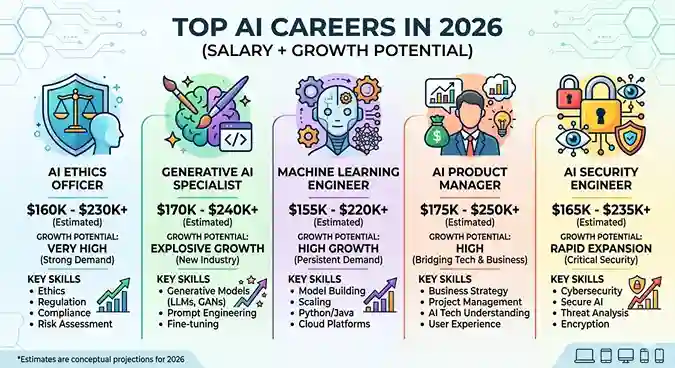
Artificial intelligence is no longer a future concept—it is already shaping how businesses hire, how products are built, and how entire industries operate. From healthcare and banking to e-commerce, cybersecurity, and automation, companies are investing heavily in AI talent. That is exactly why AI Careers in 2026 are expected to be among the most exciting and high-paying career paths in the global job market.
If you are planning your future, switching industries, or simply looking for a career with strong salary potential and long-term growth, this guide will help you understand where the best opportunities are. Below, I’ll break down the most in-demand roles, salary expectations, required skills, and why AI Careers in 2026 could become one of the smartest professional choices of the decade.
AI Careers in 2026 – Highest Paying Roles, Skills & Growth Potential
The biggest reason AI Careers in 2026 are growing so fast is simple: companies no longer treat AI as an experiment. They now use it for customer support, fraud detection, content generation, automation, forecasting, data analysis, and product development. That means businesses need specialists who can build, train, manage, and improve AI systems.
Unlike many job trends that rise for a short time and then cool down, AI Careers in 2026 are backed by real business demand. Employers want professionals who can combine technical skill with problem-solving ability and apply AI tools to real-world business challenges.
Why AI Careers Are Booming in 2026
There are several reasons why AI Careers in 2026 are becoming some of the fastest-growing jobs worldwide:
- Businesses are automating repetitive work
- AI tools are being integrated into software, apps, and customer service
- Companies want better data-driven decision making
- Cybersecurity threats are increasing, and AI is being used to detect them
- Startups and global enterprises both need AI talent
As a result, professionals who understand machine learning, data systems, automation, and AI implementation are likely to stay in demand for years.
1) Machine Learning Engineer
One of the strongest options in AI Careers in 2026 is the Machine Learning Engineer role. These professionals build models that learn from data and improve over time. They work on recommendation systems, fraud detection, predictive analytics, personalization engines, and more.
What they do:
- Train and test machine learning models
- Clean and prepare large datasets
- Improve model accuracy and performance
- Deploy AI solutions into real products
Salary potential:
Machine Learning Engineers are often among the highest-paid professionals in AI Careers in 2026, especially if they have experience with large-scale systems, cloud platforms, and model deployment.
Useful skills:
- Python
- TensorFlow / PyTorch
- Statistics and probability
- SQL and data handling
- Model evaluation and deployment
2) AI Product Manager
Not every AI role is purely coding-based. The AI Product Manager is becoming one of the most valuable non-engineering positions in AI Careers in 2026. This role connects business goals with technical AI teams.
What they do:
- Decide how AI features fit into products
- Work with engineers, designers, and business teams
- Prioritize product roadmaps
- Translate business problems into AI use cases
Why this role matters:
A company may have great engineers, but without product direction, AI tools may not solve the right problem. That’s why AI Product Managers are growing in importance.
Good fit for:
People with a background in tech, product management, SaaS, analytics, or digital strategy.
3) Data Scientist
Data Scientists remain a major part of AI Careers in 2026 because AI systems depend on clean data, insights, and statistical analysis. These professionals analyze patterns, create predictive models, and help companies make smarter decisions.
What they do:
- Analyze structured and unstructured data
- Build predictive models
- Create reports and insights for business teams
- Support AI training pipelines
Salary and growth:
Data Science remains one of the strongest career paths because it combines AI, analytics, and business value. It is especially powerful for professionals who can move beyond dashboards and contribute to machine learning workflows.
4) Prompt Engineer / AI Workflow Specialist
This role has grown quickly because businesses are using generative AI tools for content, coding, customer support, and automation. Prompt Engineers and AI Workflow Specialists help teams use AI systems more effectively.
What they do:
- Design prompts for better AI outputs
- Build repeatable AI workflows for teams
- Improve quality, speed, and accuracy of AI-generated results
- Connect AI tools with business tasks like writing, support, or research
This role may evolve over time, but for now it is one of the most interesting emerging areas within AI Careers in 2026, especially for people who combine creativity, process thinking, and technical understanding.
5) AI Research Scientist
For those who want to work at the cutting edge of innovation, AI Research Scientist is one of the most advanced paths in AI Careers in 2026. These professionals work on new algorithms, model architecture, optimization, robotics, natural language processing, and deep learning systems.
What they do:
- Develop new AI methods and architectures
- Run experiments and publish research
- Improve model efficiency and reasoning ability
- Work on advanced applications like language models, robotics, or computer vision
Best fit for:
People with a strong academic background in computer science, mathematics, deep learning, or research-based AI.
6) Computer Vision Engineer
Computer Vision is a major branch of AI focused on helping machines understand images and video. This makes it one of the most specialized and high-growth areas in AI Careers in 2026.
Common use cases:
- Facial recognition and identity systems
- Medical image analysis
- Quality control in manufacturing
- Autonomous vehicles and smart surveillance
Skills needed:
- Python and OpenCV
- Deep learning for image classification
- CNNs and vision models
- Dataset labeling and model training
7) NLP Engineer (Natural Language Processing)
Language-based AI is exploding, and that makes NLP Engineers central to AI Careers in 2026. These professionals build systems that understand, process, summarize, translate, or generate human language.
They may work on:
- Chatbots and virtual assistants
- Search and recommendation engines
- Text summarization and classification
- Sentiment analysis and language generation tools
As businesses use more AI-powered support tools and content systems, NLP expertise becomes more valuable.
8) AI Ethics & Governance Specialist
As AI becomes more powerful, companies and governments are paying more attention to risk, bias, privacy, and responsible use. That creates a new category of AI Careers in 2026 focused on policy, governance, and compliance.
What they do:
- Review AI systems for fairness and bias
- Create responsible AI policies
- Help companies reduce legal and ethical risk
- Support compliance, privacy, and trust frameworks
This role is especially important in healthcare, finance, education, hiring systems, and public-facing AI platforms.
9) Robotics & Automation Engineer
Robotics is a strong long-term area within AI Careers in 2026, especially in manufacturing, warehousing, logistics, healthcare devices, and industrial automation.
What they do:
- Build smart machines and automated systems
- Integrate sensors, AI logic, and machine control
- Improve robotics efficiency and decision-making
- Support automation in factories and supply chains
This path often suits people who enjoy hardware plus software, not just coding alone.
What Skills Will Matter Most in AI Careers in 2026?
While each role is different, some skills are becoming valuable across the board in AI Careers in 2026:
- Python programming
- SQL and data handling
- Machine learning fundamentals
- Statistics and data analysis
- Cloud platforms and deployment basics
- Prompt design and AI workflow thinking
- Communication and business problem-solving
The best professionals won’t just “know AI.” They’ll know how to apply it in a way that saves time, improves decisions, reduces cost, or creates better products.
Which AI Career Is Best for Beginners?
If you’re starting from scratch, the best entry path depends on your background:
- From coding/software: Machine Learning Engineer, NLP Engineer, Computer Vision
- From analytics/business: Data Scientist, AI Product Manager, AI Operations
- From writing/content/process work: Prompt Engineer, AI Workflow Specialist
- From academic/research background: AI Research Scientist
You do not need to become an expert in every area. A smarter strategy is to pick one lane, build core skills, and then expand gradually.
How to Start Building an AI Career in 2026
If you want to move into AI Careers in 2026, here is a practical roadmap:
Step 1: Learn the Basics
Start with Python, data analysis, and machine learning fundamentals.
Step 2: Pick a Career Path
Choose whether you want to focus on engineering, analytics, product, research, or automation.
Step 3: Build Small Projects
Projects help you prove your ability. Build a chatbot, recommendation engine, classifier, dashboard, or automation workflow.
Step 4: Learn Tools Used by Employers
Get familiar with Git, Jupyter, cloud basics, APIs, and popular ML frameworks.
Step 5: Create a Portfolio
Show your projects, explain your process, and make your work visible on GitHub or a personal site.
Step 6: Apply Strategically
Target internships, junior roles, freelance projects, or internal transitions if you’re already working in tech.
Final Thoughts
There is a reason AI Careers in 2026 are getting so much attention: they sit at the center of where technology, business, and future job growth are heading. Whether you want a highly technical role like Machine Learning Engineer or a more strategic role like AI Product Manager, the opportunities are real—and they’re growing.
The smartest move is not to chase every trend. It’s to choose a clear direction, build relevant skills, and learn how AI solves real-world problems. If you do that, AI Careers in 2026 can offer not just a good salary, but a career path with serious long-term growth, flexibility, and global demand.